Recently, I had the opportunity to replay the original Resident Evil on GOG. I bought the classic trilogy the moment I could, looking forward to replaying them as soon as I could.
Resident Evil 2 had just come out at the time, so I quickly ran through that.
When Resident Evil 3 came out, I had real life problems take over and that game fell by the wayside.
At some point, though, I never realized I was skipping the original game that started it all. When I finally noticed I was avoiding it, I tried to think about why that might be the case. Was it because there was a remake and this original was "outdated"? Was it because I liked the later two titles more in the first place? Maybe it was just the number of design choices that made sense at the time but were quickly changed for the sequels?
No matter how many possible explanations I came up with, however, there was still a glaring issue: I still wasn't playing the game.
Once I finally sat down and began playing through this game again, I started to remember what made me fall in love with the franchise. Over the past thirty-odd years, this franchise has changed significantly (I wonder what Shinji Mikami would have said back in 1996 if he saw what Requiem would look like?). But I still had some thoughts replaying this game that I felt needed to be addressed.
In a technical sense, Resident Evil wasn't my first game in the franchise. That honor would go to a Wii Edition copy of Resident Evil 4 (2005). My first experience with the game was a good friend of mine bringing her PlayStation copy of RE4 to school and showing me this cool new game her parents got her. Naturally, I was intrigued and looked the game up on YouTube later that day. Except, as a dumb fifth grader, I forgot the number "4" on the cover. Oh, well.
When I saw a two hour video of a silent playthrough/walkthrough of the game (I can't remember which word was more popular at the time), I was intrigued. The entire game lasted only about two hours? That couldn't be right, I figured.
Regardless, once that video began, I was hooked. It would be about a year before my parents got me the remake (2002), and about three years before I finally found the original game at a flea market. I think it was the original version, not the Director's Cut? I'm not 100% sure on the specific version, truth be told, but I know it took years for me to finally re-experience the original game myself.
By this point, I had already experienced:
Watching that playthrough
Resident Evil 4
Resident Evil Remake
Resident Evil 3 (1999)
The S.D. Perry Novels (All of them)
All of the movies
This game had one HECK of an uphill battle for still being fun my first playthrough. Luckily, I didn't remember any of the puzzles (except the easy ones that were on the main menu idle cutscene). But it still held that magic it seemed to hold when I first watched that video.
My Specific Playthrough
Despite how long it took to actually play the game, I've beaten it a good number of times over the twenty-something years since then. I didn't remember the exact routing to beat the game, but I had a rough idea of how to beat the game. So I decided to try to change things up a bit.
While looking into the REbirth patch, I noticed that they had a mod on the same page that enabled "Real Survivor" mode. Real Survivor was a gamemode added to the remake that kept everything the same except unlinked item boxes used to organize your inventory. Normally, if you placed a health item in an early game item box, you could open one at the end of the game and it would magically still be there. But not anymore! We added realism to this goofy game about zombies and Jill sandwiches!
On a serious note, though, I didn't remember if I ever cared enough to try the challenge on the remake version, but I know I didn't beat that game mode on the original version oof the game that didn't have that programmed in. That sounded like a fun challenge.
The only problem? This is a well documented bug in the Resident Evil 1 version of REbirth where my graphics card did not like DirectX. REBirth works properly on Resident Evil 3 on this computer (I have that installed and tested it a few times already), but it did not seem to want to cooperate with me. Without the workaround at the bottom of the Troubleshooting page, I could not see anything except for a row of text on the bottom of the screen. And with their workaround, all cutscenes had a chance of triggering a bug that looked like this.
(That specifically says "Failed to create surface" if you're curious; I got a handful of different crash messages, but didn't feel the need to document them all.)
For the Jill playthrough, this was a minor inconvenience at best. In the Japanese version of the game (which you need to install to run the REbirth patch; REbirth re-enables the English translation and the cutscenes are in English anyway), Jill's "Easy Mode" campaign does not actually use ink ribbons; she gets unlimited saves whenever she wants! I just had to save a bit more often than I'd actually like. For the Chris playthrough on the other hand, I had trouble remembering where the ink ribbons even were; on my first attempt at playing this game with the mod, I couldn't find any ink ribbons, made it to the first boss fight, played the cutscene where you take control of Rebecca, then crash.
Yeah, as much as I'd love to have played the Chris campaign with this mod, it just wasn't in the stars at this time. Maybe in the future I'll revisit it. Or play it in the Remake to compensate. So, I uninstalled the game completely and reinstalled the English version.
Now that I've given the context for these playthroughs, let's get to the actual playthrough.
Jill Playthrough
Jill's campaign in Japanese begins with the game telling you this is the easy version. The English version doesn't do this (and later doesn't when I reinstalled for Chris). Truth be told, I haven't the slightest clue why.
Then, we get one of a handful of live action, cheesy horror cutscenes of our main cast discovering... gasp! Zombies! If you've never experienced this game yourself, there's no way to truly explain how cheesy this game is without just showing you the game directly. I make jokes throughout this review and poke fun at this game, but it's jam-packed with the weirdest writing choices and worst voice acting imaginable by people who were literally not even voice actors before this game. The history of identifying this game's voice actors is actually quite crazy, I'd recommend looking into that on your own if you're interested.
"Jill, have you found Wesker yet?"
"Nope! I checked beside the stairs we're already standing next to, he wasn't where we would have seen him."
"I couldn't find him from standing in the exact same spot, either."
It doesn't take long for the group to split itself as thin as possible. I think that's standard S.W.A.T. training: Once people start going missing, split up like the Scooby gang and search for clues.
Every Resident Evil game has some form of tank controls (that just means "Pressing W moves the character model forward, not up on your screen"), but the earlier games had a mix of tank controls and fixed camera angles. I understand why people aren't the biggest fan of that combination, but I think some of the hate these games get for this combination is a bit over-the-top. I'm rather used to it, to be fair, but it didn't confuse me as a child that was used to more modern control schemes (which were still tank controls, just without fixed camera angles), so I can't imagine it giving people who actually give it a shot too much trouble. Maybe a few minutes to get used to it.
The more frustrating game mechanic (one that I still enjoy but I understand people not) would be the inventory system. Jill gets a total of eight inventory slots, and Chris later gets a total of six. If you want to free up an item slot, you either have to use up the item or find an infinite item box to store some items in. It's significantly easier to maneuver in Jill's playthrough, given she has more item slots and doesn't need to dedicate as many to keys, but we'll talk more about that when we get to Chris's playthrough.
And our first mission? Find four tablets that act as keys to the backyard... Sigh, at least you don't have to bring them in one go. I mean, I did because I knew what I needed to bring for the backyard segment anyway, but it's still not helping my case with the inventory system.
Now, where are those four tablets? Oh, locked around the mansion behind weird puzzles and a giant snake. No big deal, really.
Regarding our item management problem, though, we need to come up with a solution for where to store our items. In a normal game, you can shove them in any item box, but in this game, you need to keep track of every item's location. The simplest solution would probably be to designate one "general" safe room with an item box to use to store any items you want to keep track of, and only use the other item boxes while you're there and take what you need when you leave. This is a lot easier when you know what you'll need, but general rule of thumb: Bring only the weapon and ammo you know you'll use, bring a health item if you think you're likely to take damage while you're there, and the key items you'll immediately use (you probably know them already if you're tackling this mod, or the challenge in the remake).
The good news? Once you get to the backyard the first time, you don't need many items. All you really need at this point (for either character) would be a shotgun to quickly take out zombies and some extra shotgun ammo in case you run out (you'll pick some up while you're in the backyard facility). You don't even need your handgun, and you probably won't need it the rest of this run if you play your cards right. You'll pick up plenty of health items while you're here (including almost immediate access to two full health items if you left enough room in your inventory to mix them and you'll have to pick up a crank on your way to the lab.
Inside the guardhouse, you'll pick up a fair bit of shotgun ammo; this will be your primary weapon until/if you pick up the Colt Python later. You'll also find some more health items to use if needed. The only thing you'll need to be weary of is that there's a book you'll have to pick up for an optional puzzle for Jill, then that option involving three or four inventory slots (three bare minimum), all to make a boss fight easier. Then, you'll have to pick up a key after the boss fight to return to the mansion.
Leaving, the only items you'll need for a fact are the crank you needed to get to the guardhouse and the key you found for two inventory slots; ideally you should bring your shotgun back with you (you'll need it in a minute) and the ammo it came with. That'll leave you with four extra slots for whatever health items (or handgun ammo if you really want them) to bring back.
Then, once you return to the mansion, you get a cutscene and...
I haven't talked much about the enemy designs in this game, but this game features more than just your run-of-the-mill zombies. I won't explain why there are monsters in this mysterious mansion as to not spoil the surprises for you, but the game makes sure to explain why each of them exist and their special place and purpose in the mansion. The early game will mostly consist of standard zombies (and the occasional zombie dog), but once you return to the mansion for your second visit, most of these zombies are replaced by creepy, reptilian Hunters that gave me the heebee jeebies as a kid. Later, you'll also run into disgusting looking bug like enemies (I think they're supposed to be giant cicadas?) that are thankfully tame compared to the remake's version. They're not jarring enough where you feel like you're playing a different game, but they're juxtaposed well enough that it feels like the game's broken into pseudo-chapters that make planning ahead easier.
You also shouldn't have any problem with ammunition once you get used to this game's quirks and what it wants you to do. You'll start to get a sense for how dodging works and which enemies don't need to be taken out, and which enemies are weak to which weapons is fairly intuitive. That website I linked to earlier for the maps also has enemy and weapon breakdowns if you need it, but I'm willing to bet you won't as long as you don't go around wasting ammo willy-nilly.
Once we return to the mansion, we can start unlocking the last rooms that were getting on our nerves earlier and...
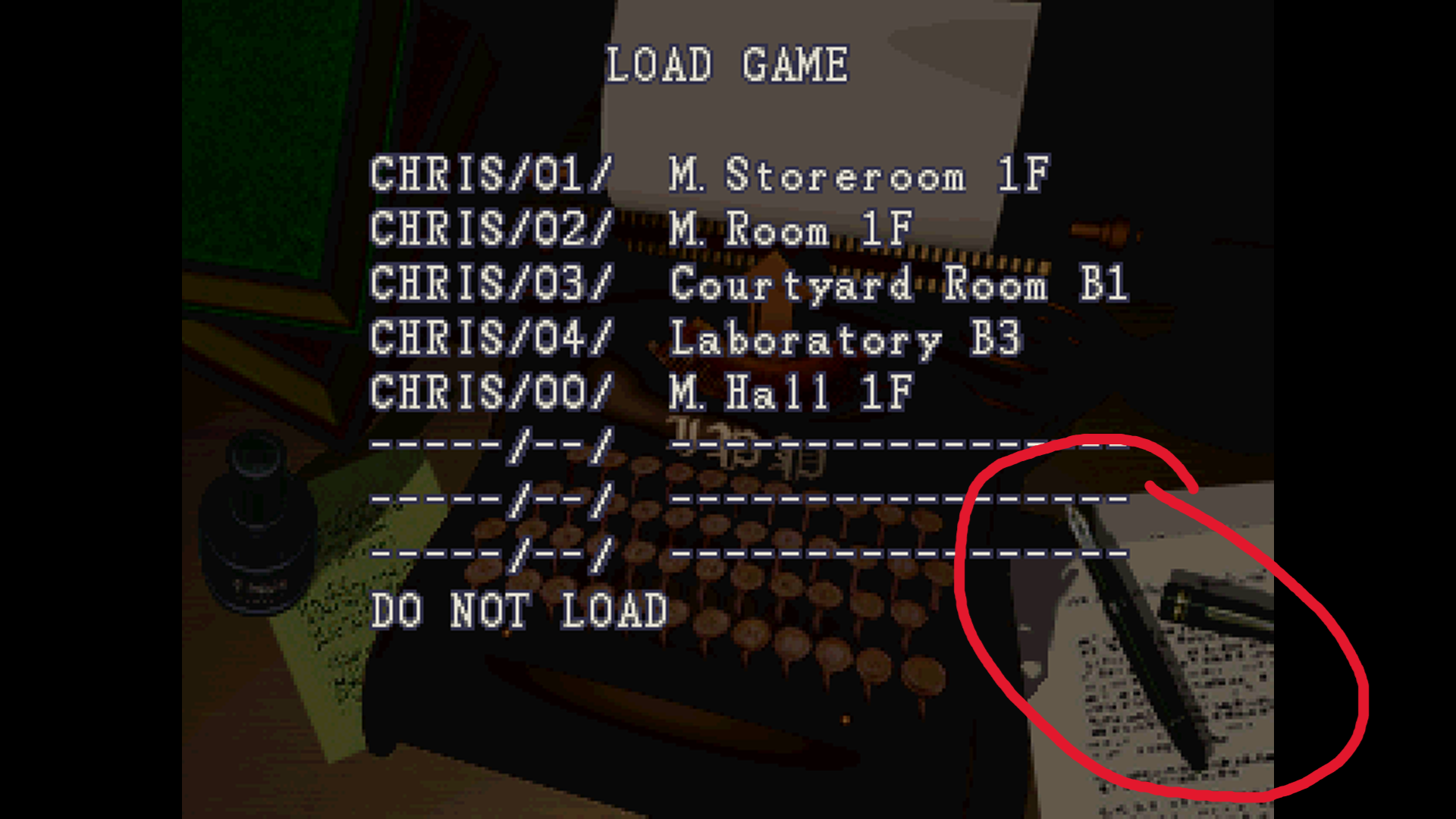
Wait. What is that?
Computer, zoom and enhance.
Is that a quill pen??? What kind of over-the-top weirdo uses a quill pen casually in their office like that in the year 1996? At least use a--
Once you return to the mansion, it does become a bit of "second verse, same as the first." While the zombies have mostly been replaced regardless of if you killed them earlier, and while there are a few new areas to explore, you do have to backtrack through the same parts of the mansions with the same number of enemies as if you never defeated any in the first place in the same locations, give or take one or two here and there. Luckily for us, the new areas only have regular zombies and you probably won't be here for long.
Something I haven't touched on yet in this game is that this game has multiple endings, something common at the time in the genre but not as much in modern survival horror games. Again, I won't spoil how to unlock these endings, but to achieve the best endings you have to successfully save two of your NPC partners. For Jill, you need to save Barry Burton (a fellow zombie-fighting officer who's been giving you occasional support throughout the game) and Chris Redfield (the other protagonist you can play as). One requires certain objectives to be met, and the other requires some item management and puzzle solving. Your second foray into the mansion will be your first opportunity for both of these triggers for Jill. I'll touch more on the multiple endings during the Chris portion of the review and the Remake Culture section at the end.
I think my only major gripe with this game is that this segment is the only segment where you can pick up a key item that won't be useful for a long while. At this point of the game, there are two segments after this: The Underground and the Lab. Even ignoring the items needed for the good ending, there is a key item you can pick up as soon as you return to the mansion (it's actually in that room I was just joking about with the quill pen") that will not be needed until not the end of this segment, but after you leave the mansion, return to the backyard, enter the underground, and complete that entire segment to unlock the lab at the very end. At least with a normal playthrough, you can shove the item into an item box and pick it back up later. I can't quite complain about the difficulty of my modded challenge run, at least, but if you missed this key item, then you'll have to come all the way back to the mansion to find it (and that's assuming you even know where the item is you forgot to grab). There isn't even a clue for where you should check for the missing item.
Regardless, it's off to the underground.
Heads up: The underground is about to flood with very tough enemies that can jump, and you only get one health item at the beginning and one at the very end after you're a hair away from escaping into the next area. Going in here, you'll need whatever your main weapons are, the crank from earlier, a slot for a new crank, a slot for a key item to open the next area (and a slot for the one I just mentioned if you're playing this mod), and two slots dedicated to the good ending items.
The underground area also has two instant death traps. The rest of the game doesn't have any instant death traps, they're exclusive to this underground area. I won't spoil which they are, but failure is an instant game-over, sending you back to the main menu to reload a save. Don't worry, you'll immediately figure out what the traps are once you see them, you'll just have to react fast enough to get out of the way.
Then, finally, we have the final area.
I'm not even going to talk about it. This area's a joke. If you have your shotgun or bazooka with you then this area will take a little while, or if you go in with a Colt Python magnum then this area will be very short. For the finale area, this area was fairly anti-climactic in my opinion. It does answer a few of the mysteries surrounding this mansion, but the only "scares" to be found are "giant bug creatures" and "uh... naked zombies? The heck?" I guess zombies can respawn now, so that's spooky?
I can't even praise the final boss fight. It's way too easy if you use anything stronger than a handgun.
If you earned the Best Ending then there is another boss fight, but that's only slightly more powerful than the previous boss fight, and you only need to survive long enough to get the only weapon that will do any damage at all to it.
Then finally, once you're done...
Not a bad time at all, especially for a Good Ending. That last puzzle for Good Ending kept getting on my nerves, though. I think it took me ten minutes to get the hang of moving items around.
No time to waste, let's get started with the Chris playthrough. It shouldn't be too different, right? Besides, after that playthrough on Easy, I'm excited to see what Hard has in store.
Chris Playthrough
Chris in the original, unmodded game begins similarly to Jill. The only difference starting off is that Chris is almost immediately isolated rather than given an awful game of hide and seek to play. I do wish we at least had a scene of Chris Redfield going "Let me check to see if they're hiding from me behind this pillar. Maybe this is a surpise party?" This series loves silly one-liners like this, and I found Chris's playthrough lacking compared to Jill's. At least he makes up for better comedy in general.
Chris's playthrough in general is fairly different compared to Jill's. Jill has a total of eight inventory slots, but Chris has a total of six. On top of this, Jill has a lockpick that does not take up an inventory slot, whereas Chris has to fetch (optional) small keys that take up an inventory slot each.
Honestly? I remember this being a much bigger deal when I was younger than it was now. I only found two small keys in the mansion. When researching I learned there were two more hidden outside the mansion, but I didn't even need them to get through this playthrough with more than enough resources. This might be a bigger issue in different game modes, but the GOG version of this game didn't come with Arranged mode like the Director's Cut version. I immediately used both of the keys I picked up, too, so they didn't take up inventory space for long.
Chris soon meets his NPC companion, Rebecca Chambers, a rookie S.T.A.R.S. officer and field medic on a different team than Chris who immediately pepper sprays him. I'm not even making a joke. She thinks he's a zombie despite not looking or acting like a zombie at all. All this cutscene does is introduce Rebecca and make you choose if you need to save her life later or if she's already safe for the Good Ending. Moving on.
Once you begin exploring this part of the mansion, you soon find a giant piano and a copy of Moonlight Sonata hidden behind a bookshelf. If there's anything I learned in band class as a kid, it's that you should always store your sheet music on a shelf hidden behind a shelf if you plan on playing it.
"Damn, Rebecca, you suck at this!"
"Sorry, I'm a bit rusty."
"I can't even read that and I think I could have played that better!"
"Then either let me practice or get lost."
Jill had this same puzzle too, but luckily for that Easy rating, Jill just happens to be a musical prodigy and plays this song on the piano perfectly (was there any indication you should play a loud piano in a mansion full of zombies hunting you down? Not at all, Jill did it for the love of the game). Chris, on the other hand, never learned how to read music. Luckily for us, Rebecca just happens to walk in at the same time as us finding the music sheet and... uh... staring at the piano as if we were about to play the song even though we don't know how to play. Seriously, you have to attempt to play the music just for Chris to go "Uh, no" as Rebecca conveniently walks in and offers to play it for us.
If only she was as good as Perfection Herself, Jill Valentine. We don't accept Jill slander around here, Jill is perfect and deserves to be. Rebecca would canonically be interesting if she didn't canonically just survive her own zombie apocalypse hours earlier and walk into this mansion and suddenly develope a case of Prequel-itus.
Now we have to leave and let Rebecca practice. If you stand outside in the hall, you can hear her practice by just playing this song in-order instead of practicing certain parts that are giving her trouble. If you return a few minutes later, she'll say she got better at the piano and plays the song for you, then plays it so perfectly that a secret door opens up!
Based on how this hidden door opened, there has to be a sensor somewhere that either measures key strokes in the piano or measures the audio in the room. I'll give Rebecca some wiggle room to not play this perfectly since any individual traits while playing would change the "key" opening the door, but she has been playing it in order this entire time. If she's only now unlocking the door, then this would mean this is the first time she played the piece well enough to play it "right." That means it must have been a coincidence that she solved the puzzle as we walked in. She genuinely saw Chris-senpai walk in and shouted "Look! I'm doing better!" and got EXTREMELY lucky.
This is why we stan Jill Valentine 'round here.
"Thank heavens you were nearby and could run and do that chemistry puzzle for me, Rebecca. I was almost toast."
"Thank heavens I forgave you for that piano comment earlier. I was almost not here to care."
(Yes, this area is that dark, by the way.)
Give or take the placement of certain items and keys (mostly Chris having fewer weapons at his disposal), the mansion plays out relatively the same. Chris has to find the same items, Chris has to take the same slabs to the same, Chris has to solve almost all of the same puzzles (there are two puzzles where Rebecca has to take over: the piano puzzle I just mentioned and the chemistry puzzle I mentioned earlier during the Jill playthrough). The biggest difference ultimately comes down to item management, a different amount of HP, and slightly different routing at one point thanks to NPC companions (both characters having an ending flag tied to the player's actions).
Where Chris's scenario shines compared to Jill is the chemistry between him and Rebecca compared to Jill and Barry. In Jill's game, while there are a few quips in the beginning (including an easily missable one I didn't get this playthrough but referenced earlier), most of her interactions with Barry revolve around Jill trying to figure out if Barry is acting suspiciously or if she can trust him in the end. There's no question in Chris's game regarding if he can trust Rebecca or not. When the two are together, they are unintentionally the funniest comedic duo I've seen in a video game.
My incorrect captions add a bit of snark to their relationship, but they have the most playful banter every time they see each other as they try to solve the mysteries of the mansion. Part of it is so-bad-it's-good writing, of course, but that's part of the charm of this game. There's a segment of the game where the field medic Rebecca Chambers sees a virus that turns humans into zombies and decides the best explanation is to blow up all the evidence of who created the virusANDrelease the virus into the air and just hope it's not an airborne virus.
"I just realized we forgot to collect evidence all this time."
"Oh, you're right. Let's blow it up."
"Great detective work. Thank goodness there's no one to hold accountable for this tragedy."
As was the case in Jill's playthrough, you have the option to save two NPCs to achieve the best ending: Rebecca and Jill. Luckily for us, saving Jill is locked behind the same exact puzzle Chris was locked behind in her playthrough, and Rebecca's survival is significantly more straight-forward than saving Barry. Just save her from danger. No, really, that's it. If something might put her in danger, try to avoid it. If you accidentally get the one question that matters incorrect, you'll even hear a loud shriek coming from Rebecca that tells you to go find her as soon as possible to save her.
The entire end-game plays out the same way. Fight giant boss, it's extremely easy even for Chris's limited weapon pool (he still can find the most powerful weapon anyway), and if you saved both NPC companions then you'll fight a slightly tougher version that can only be defeated by a final-boss-fight-exclusive-weapon that you're given after a time limit. Then, once you leave the mansion and live long enough to fight boulders or whatever it is Chris does in his free time...
Huh. Under two hours. Truth be told, I didn't have near as much experience with the Chris side of things as Jill's. Even without having to worry about the item bx, I thought the Chris playthrough would be longer than her's, let alone shorter by almost twenty minutes.
Now that both campaigns have been completed, and there are no bonus campaign mini-games to play, did I like playing through these games? Well, yes, but it's a bit more complicated than that.
Remake Culture
Remake culture in the early 2000s wasn't nearly as prevelant as it is today. At the time, remakes were rare enough that "We can do this better with newer tools and hardware" didn't feel like an excuse for a cheap cash grab. Not to say that all remakes were bad, but they weren't shoved down our throats as they are today.
Did this game need a remake almost a decade later? Did the original source material greatly improve with some polish and a new coat of paint?
I think part of why I procrastinated replaying this game for so long was that we had a remake that was technologically superior. I'm not going to pretend that the original Resident Evil was some masterpiece that its remake missed the point of (that honor goes to a different Resident Evil remake). It has its flaws, it aged more compared to the next two mainline games, and the remake fixed the "issue" of the tank controls that was actually an issue regarding fixed camera angles that they blamed the tank controls on and gave players a new movement system.
But playing through the 2002 remake, it feels like a remake of something people loved. It's technologically superior, but almost all of the charm was taken with it. It's darker, grittier, drier than the original. I can only remember one quip that game makes, and it's specifically a quip that was taken straight from the original game but with the same dry tone as the rest of the game.
Regarding the voice acting, the voice acting in the 1996 game is awful, but that's part of what makes it memorable.
The goofy and terrible writing is what made this game unique. Even compared to Resident Evil 2 a few years later, that game's writing and voice acting are more grounded compared to this game's. Resident Evil (1996) has a certain Bride of Chucky feel to it, whereas Resident Evil (2002) has a certain Child's Play 3 feel to it, if that makes sense.
For a long while, there was talk around a potential remake of Resident Evil 2 (1998), and one finally came out of no where in 2019. At some point, "What would this game look like if it were made with today's technology" became "What would this game look like if it were made by today's standards." I'm not going to discuss in this post how well Resident Evil 2 (2019) tackled that, but it still goes to show what Remake culture has become.
Look at the original and understand it at a surface level
Redo it but without understanding why it was made the way that it was
Call it a success because it's new
The movie industry learned that lesson a while ago (and created an arguably worse problem in reboot culture), but the video game industry seems to only now starting to learn about this phenomenom itself.
If you want the shiny thing without the charm, play the 2002 version of this game. It's mechanically better and, if you skip all the cutscenes, you won't even notice it.
But if you want to see where this franchise started and how it became a hit, start from either the original or the Director's Cut (or the Nintendo DS version-port-thing if you're feeling up to it). The original has a special je ne sais quoi that the remake intentionally threw to the wayside. While recent Resident Evil games may have intentionally dropped that je ne sais quoi and wrte in a different direction, this game severely lacks without those pieces that made it a timed (maybe not timeless) masterpiece.
See Also
This game currently can be purchased either physically from third party sellers, or online at GOG/Steam. Both sites also sell this title in a bundle with the other two original Resident Evil games, Resident Evil 2 (1998) & Resident Evil 3: Nemesis (1999). Neither of these links are affiliate links, I make no money off of purchasing the game from either store.
For a large portion of the Jill section, I linked to EvilResource, a Resident Evil fansite that does not write direct walkthroughs of the games but instead provides interractable maps, enemy data, item locations, puzzle guides, etc. This website was a great resource for planning and routing. They also cover side campaigns and mini-games.