Pokémon Note Taking
Alternate Title: Who Let Ruki Info-Dump About Notebooks, Note Taking, and Pens Again?
Lately, there has been a fair bit of talk revolving around how to take notes in competitive Pokémon. You may have seen Wolfe Glick's new VGC Notebook and heard some buzz around what's allowed and what you can do to improve with your hobbies.
Taking notes, especially hand-written notes, is a great way to improve your skill in any hobby. An article from Scientific American goes a lot more in-depth on that topic than I normally would on the topic (my normal excuse is "I collect fountain pens, may as well use them"). In their article, they explain,
That work suggested that people taking notes by computer were typing without thinking, says van der Meer, a professor of neuropsychology at NTNU. “It’s very tempting to type down everything that the lecturer is saying,” she says. “It kind of goes in through your ears and comes out through your fingertips, but you don’t process the incoming information.” But when taking notes by hand, it’s often impossible to write everything down; students have to actively pay attention to the incoming information and process it—prioritize it, consolidate it and try to relate it to things they’ve learned before.
Why Writing by Hand Is Better for Memory and Learning
Written by Charlotte Hu
Edited by Lauren J. Young
While that quote was referring to taking notes during class, the same principles apply during competitive Pokémon (especially in VGC in particular since every match is timed). Wolfe Glick made their notebook to use during traditional VGC tournaments that use Best-of-Three matches, but his notebooks are adaptable to whichever version of Pokémon you're playing.
And I'm here to show you how to make your own personalized notetaker using the same principles.
Why Make Your Own?
Wolfe Glick's notebook looks to be good quality from what we can see in his video (linked here if you want to buy his yourself and not make your own), but not every notebook is created equal from a technical sense. Some people like spiral notebooks and perforated pages, some like hardcover binding that can't be torn out, some like making their own binding with special quality paper. I don't know looking at that video how friendly the paper is towards fountain pens (probably not), so this notebook probably isn't for me in that physical sense. This blogicle is not meant to be a "this product sucks, mine is better" post.
This is instead meant to be a guide for anyone who knows this product isn't for them in particular and want help figure out their right tool.
The number one reason someone might want to make their own is a simple one: economics. Maybe you already have a stack of unusued notebooks sitting in a box in a supply cabinet pleading to be used. Maybe you can't afford an expensive notebook.
Another reason might be that you use those specialized tools. I mentioned already that I primarily use fountain pens. Not every paper is fountain pen friendly; either they tear easily and get stuck between the tines of my fountain pen nibs or the ink bleeds through and you waste many pages because thinner paper was designed with ballpoint pens in mind. Many people use assistive technology that support their needs that normal notebooks may not be able to accomodate.
Most importantly — and I make this same recommendation for anyone who tries to start hobbies like journaling or notetaking in general — making your own material that stand out to you greatly increase the odds of you growing attached to them and using them. Every notebook I've made with a specialized purpose means something to me, and every fountain pen I own means something to me and I try to use them all for different tasks.
What's Actually Allowed in a Pokémon Notebook?
The Pokémon Company doesn't actually have many rules in place for how you take notes. Quoting the current Play! Pokémon handbook,
...(T)the following items are not allowed on the play surface:
- (...)
- Prewritten information, such as a turn sequence, notes from a previous match type charts, etc., both physical and digital
- Competitors may utilize a preconstructed outline for note taking, which must be blank at the start of a match and can be comprised only of lines and simple shapes (no words or symbols)
- Use of preconstructed outlines is up to the discretion of the Tournament Organizer, and competitors must follow any instruction regarding preconstructed outlines for note taking. If bringing a notepad or other paper implement to a match, sheets must be free of writing, and a competitor should not refer to old notes from a previous match during their current match.
Play! Pokémon Tournament Rules Handbook ⬝ English Version ⬝ Last Revision: April 7, 2026
Section 3.2.1 ⬝ During Tournament Play (pg. 12-13)
You should probably check with your Tournament Organizer ahead of time (and keep some blank paper in your book just in case), but as it currently stands, you can create whatever you want as long as what you create is simply a template you fill in during the match without anything already written down.
Supplies
The great thing about making your own notebook is that the supplies can either be really short or really long depending on the type of project you want to take on. I'll go in-depth of the details for each in their own section, but first, here's a general list of supplies you might need. Read through the supplies, figure out the type of project you want to take on, then read the rest of the post before buying the rest of what you need, or follow a mix of both.
Low Tech
- Prepurchased Notebook
- Outlining Pens (For lowest tech, I'd recommend simple black ballpoints)
- Ruler/Straight Edge
Mid Tech
- Binding Tech (I recommend a hole punch binding system such as your standard three-hole punch for binders, six-hole punches, or eight-hole punches)
- Paper (and printer if you print pre-made templates)
- Outlining Pens (In a variety of colors to color-coordinate sections)
- A Pen Special to You for Actual Notes (Seriously, having a special pen drastically increases the odds of using the pen because you want to use the pen)
High Tech
- Office Suite Programs (To make or plan templates to use)
- Cricket (To make special sticker inserts to add to your pages as needed instead of printing full pages)
Now, how do you know which version of the project is right for you? The answer to that question is how much you want to personalize and how you want to use these books. I recommend you do whichever version stands out for you (doing the bare minimum will suffice; you'll find ways to personalize these books anyway).
Which Notebook Should I Use?
With any luck, you already have the perfect notebook. If not, no worries, most stores these days sell at least decent quality notebooks somewhere.
If you want to "reset" the notebook for each event, then one of the refillable bindings would be the best option for you. This also makes it a lot easier to "refill" the book when you're done instead of going to buy a new book each time. If you want something refillable, then I'd recommend one of many hole-punch systems, but I normally use eight-hole Tūl notebooks. Tūl is a brand owned by Office Depot, which sells a ton of different supplies including premade discbound sets. A5-sized books will probably be the easiest to carry around. The only issue with A5 size in particular is that, if you print your own templates, you will have to either get A5 paper just for this project or cut paper down to size, resulting in plenty of paper to recycle. Tūl (and many companies) do sell refills for both lined paper and dot grid paper, however, if you would prefer to make the grids yourself.
Likewise, if you want to be able to keep your notes sturdy and in one spot, a hard-binded notebook might be the right one for you. There are many companies that make hardbound notebooks (a common decently-expensive option being Rhodia notebooks), but I'd recommend a Pen+Gear Notebook personally. They're good quality binding, they're good quality paper, they have neat ribbons built into the binding to use as bookmarks, and they come with folders at the end to store stray papers in that you receive during events (such as receipts or slips you need to keep track of).
If you want a book that's easy to open and takes up the least amount of space, any variant of spiral notebook (or discbounds if you choose to go that route) can be flipped over to only take the space of one page or one cover. I don't use spiral notebooks often, so the only recommendation I can make is repeating the Discbound system again.
Choosing Your Paper
Even if you're choosing a notebook that's already made, it's important to note what kind of paper you're working with in your notebook. Some papers are thinner, some papers are thicker. Some papers are smoother, some papers are rougher. Some papers are as white as you can get, some are more of a creamy color. Whichever paper you choose will drastically change how the book feels when you use it. Some can be torn out with ease, some cannnot be torn out.
Further, if you're physically making your book using a refillable system, you have to decide whether you want to make the templates yourself or print them out and put them in the book later.
If possible, I'd recommend going to your local store that sells paper and physically getting a feel for the paper yourself. Stop in your stationery aisle, open up a few notebooks, and physically touch the paper to see if you like how it feels and how it looks.
While you're looking at paper, if you plan on making the templates yourself, it's worth debating whether or not you want to use blank paper, lined paper, lined grid paper, or dot grid paper. I personally use dot grid pages because these are easier on the eyes for me but help with making charts and templates yourself. However, I know many people who hate seeing all those dots on their paper and would prefer simple lines. Whichever you choose, make sure the style you choose matches the book or paper you're buying.
Also, make sure the paper is good quality for the tools you're personally using. Is your paper good enough quality where your felt markers for borders won't bleed through? Is your paper so thick you cannot put many in the bindings? Does the paper in the premade book have background designs that are distracting? If anything stands out to you as something you won't want to use, the paper will quickly get on your nerves.
Making Your Notes Templates
Now it's time to make your own note templates and outlines.
Now for some good news and bad news.
The good news is that a few people have made their own templates that are floating around on the Internet.
The bad news, though... Someone showing you their note taking system does not make you an amazing Pokémon Trainer. Wolfe can explain how to use his system, but unless that system works for your mind, your note taking style, and your project, those notes are not going to help.
There is a bright side to this, though: If you understand how you best learn and you can understand what these premade templates are designed to do, they're significantly easy to adapt for your needs.
For example, here's a template I made up in Microsoft Excel. I used Microsoft Excel because I use a Pen+Gear Dot Grid Notebook and Excel lets me highlight different cells to emulate different sections in the grid. In my case, I made a thick border around the size of my pages, then counted off the grid outside of those borders. Similar programs such as LibreOffice Calc or Google Sheets should help you achieve a similar effect. This particular template is adapted from what we saw in Glick's video but designed for the Doubles ladder in Pokémon Champions.
Best of One Ladder (Doubles)
Best of One Ladder (Doubles)
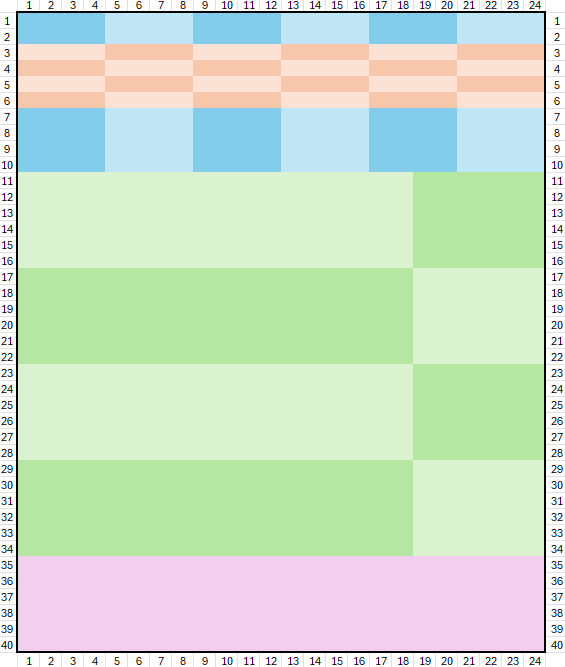
You could blindly recreate that template on your paper (adjusting for your page or grid size), or I could walk you through how the template is designed and you can determine which parts you can use yourself.
Now, how much of that explanation you use versus how you adapt that template to fit your needs is up to you. Maybe you rarely play Doubles but you play Singles all the time? This template could be further adapted into a Singles version instead (one that more closesly remembers the Wolfe Glick template). Maybe you don't want that second set of blue boxes but conveniently need an extra row for each of the green sections. Maybe you skip the final recap completely. That's up to you.
Personalizing Your Notebook
This is your notebook. If I'm reading that Play! Pokémon rule correctly (and I think I am because otherwise the Wolfe Glicke notebook wouldn't work either), you can have whatever you want in the notebook as long the only part of the notebook that's "out" during the match is your notes for this particular match. If you want a page to doodle on between rounds, add one. If you want to put stickers on your notes after the fact to make them look cuter, feel free. If you want to keep another section of more specific notes such as flow charts or interactions to study, make an entire separate section for them. That's the beauty of creating a system for you: it matches your individual needs.
You can also make specialized pages if you are making a book for a special event or want to use the same notebook for multiple events. You can dedicate a page to maps of venues, or a page to post your event team sheet to look back on later, or checklists for anything you may want to buy while you're at the event.
Further, if you're making one yourself, make anything you think you will need in this notebook. One thing I love about my hardcover notebook I plan Rukinations in is that it has ribbons built into the cover I use to mark two different pages to go back and forth between. If you want one of those ribbon bookmarks, make one. Alternately, you can make section tabs for you book and pre-partition the book for different tasks. This is the perfect time to make this book into something you will care about (just be careful not to go too overboard).
Closing Thoughts
If after all this you decided you would rather buy Wolfe Glick's notebook, or buy someone else's premade note taking notebook, then go ahead. This was not written to scare people away from buying one product or another. This was written to help you create your own note taker for any format if you would like and create something that works for your mind.
Sometimes, we don't need to reinvent the wheel, and that's okay.
But not every wheel is the same. You are not going to use a rubber tire for a bicycle on the cart you use to move through the office. If you've looked around every tire store and can't find the right wheel, look at the device you're making a wheel for and determine if there's something you can make yourself.
See Also...
For Pokémon-related resources...
- I Spent a Year Designing a Piece of Paper by WolfeyVGC
The video that started this note taking discourse on Twitter lately. - How to Use Cornell Notes by Learning Strategies Center Cornell
Another note taking system that might be good to adapt for this environment. Use the "cue" to write down Pokémon and information you can immediately deduce, the notes section for notes during that match, and the summary section for recapping the match and what you would have done differently if you were to play the match again.
For note taking in general...
- @BulletJournal on YouTube
While I did not use the Bullet Journal method in this post or in my Pokémon-related notes, their YouTube page does include many helpful note-taking resources. I also recommend bullet journals for notes in general, though I've never used the actual Bullet Journal-branded book.